
Uzbekistan has two languages in which no book was ever written, no newspaper printed, no lesson taught. One was brought by Arabs: the first came with the armies of the Caliphate in 709, when Bukhara was taken, while the ancestors of today's speakers most likely moved here from around Balkh six hundred years ago, under the Timurids. The other was brought by Koreans, in freight cars, in the autumn of 1937. Both languages survived into our time for one reason only: people spoke them at home. And both are now falling silent, for one and the same reason.
Today, a few hundred people in Uzbekistan would understand these two sentences. Almost all of them are over seventy.
This is not a story about the exotic. The Arabs of Bukhara and the Koreans of Tashkent are ordinary Uzbekistanis: neighbours, classmates, people at the market. It is just that at home, in the kitchen, over tea, until quite recently they spoke a language that exists nowhere else in the world.

Bukhara Arabic has the word ǧazīra (jazira). In every other Arabic it means “island”. Here it means “desert, waterless steppe”.
A language in which “island” came to mean “desert” is the language of people who have not seen the sea for a thousand years.
Arabs have been in the Zarafshan valley since the early eighth century: in 709 Qutayba ibn Muslim took Bukhara, in 712 Samarkand, and Arab garrisons were stationed in the cities. Under the Samanids, in the ninth and tenth centuries, there was a whole Arab town near Samarkand, Vedar, famous for its textiles. But today's Bukhara Arabs are most likely not the descendants of those soldiers: linguists believe their ancestors arrived later, in the fourteenth and fifteenth centuries, from around Balkh and Andkhoy in what is now northern Afghanistan, under the Timurids. So this language has been here for at least six hundred years, and Arabic speech in Bukhara for thirteen hundred.
By the early twentieth century Arabs lived in several dozen villages of the Bukhara and Kashkadarya oases, and in most of them they had long since switched to Tajik or Uzbek. The language held out in three. Jogari and Chagdari near Gijduvan, Arab-khana near Vabkent. Plus Jeynau and Kamashi in Kashkadarya. That is all.
How did it hold out? The answer is simple and not very comfortable: Arabs married only Arabs. The village kept to itself, brides were taken from among their own, and the language was passed on along with blood. Linguists call this endogamy; the Arabs themselves called it the proper order of things. It worked for a thousand years and stopped working the moment school, the collective farm, the passport and the city appeared.
In 1936 the Leningrad Arabist Isaac Vinnikov came to the Bukhara region to record this language. He caught it at the last moment. Here is what he was told in the village of Chorrabot, not by scholars but by the villagers themselves:
“There are few Arabs left. They have all become Uzbeks, they speak Uzbek. They are called Arabs in name only; they do not know Arabic. Their old people have died, and the young cannot speak Arabic.”
That was said ninety years ago. The language was dying even then, and it is still alive.
Vinnikov did what today would be called documentation: he travelled to the villages in 1936, 1938, 1943 and 1944, and in 1937 he brought Tosh Gani from Arab-khana to Leningrad, simply a native speaker, a village man, to write the language down from his lips. The result came out in 1962: a dictionary of two hundred and fifty pages where each word has not only a translation but the sentences in which it was spoken, and often whole stories. It is the only dictionary of Bukhara Arabic. There is no other, and there will not be.

It is Arabic, but it resembles no other Arabic. For a thousand years, side by side with Persian and Turkic languages, it rebuilt itself. The verb moved to the end of the sentence, as in Uzbek. The article disappeared. And the present tense came to be formed with the word “to lie”: to say “he is baking bread right now”, you literally say “he bakes lying”. A Turkic converb, translated onto an Arabic root.
But more important than the grammar is what the language preserved.
The word ḳalb, “heart”, is the longest entry in Vinnikov's dictionary. There is no separate word for “to love”. To fall in love is “to become attached with the heart”: 'al_ba'áz ḳalb šaddu (al-ba'az kalb shaddu), “they became attached to each other with the heart”. To calm down is “the heart opened”. To be fed up is “the heart struck”.
And one more thing. Asked “what language do you speak?”, people in Jogari answered:
nāḥna salās ilsānāt nithaddas (nākhna salās ilsānāt nithaddas) — “we speak three languages”. Arabic in their own village, Tajik in a neighbouring one, Uzbek in town.
In 2000 the Georgian Arabist Guram Chikovani came to Jogari with a video camera. He filmed a boy of about eight, Ahmad Ali Rajabov, speaking Arabic, the family of Abdu Jalol Jahonkulov, and old men in Jeynau telling tales.

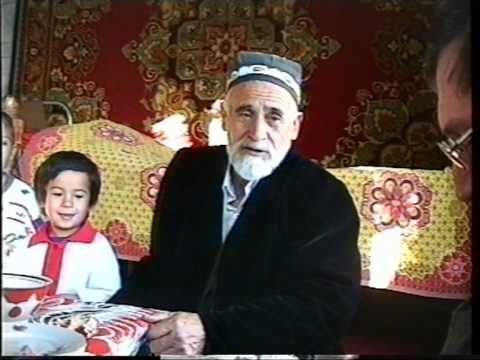


Ahmad Ali is now about thirty. Whether he still speaks Arabic, we do not know. In 2025 Chikovani wrote that the language in the villages is still alive but “confined to the family”, and the young are moving to Uzbek and Tajik.

The two stories have nothing in common. The Arabs: a thousand years in one place. The Koreans: three generations after deportation. Different ends of Asia, different religions, different food, and neither has an alphabet of its own.
One thing is shared. Neither language was ever the language of anything but home. Nobody taught in it, wrote in it, judged in it or prayed in it. It lived exactly as long as a grandmother spoke it to her grandchild. The moment the grandchild answered in another language, it was over.
Linguists call this “interrupted intergenerational transmission”. German Kim, a historian of the Koryo-saram, called Koryo-mar “a dialect without a roof”: a vernacular with no literary language above it to hold it up. The phrase fits both. Two languages without a roof.

The word 따깐 (ttakan) is the Russian word “stakan”, “glass”, with its first letter knocked off. Korean does not like two consonants at the start of a word, so “st” became plain “t”. In the same way “spichki”, matches, turned into 비지깨 (pijikke). Mothers came to be called 마마 (mama), fathers 빠빠 (ppapa). And the polite “you”, 당시이 (tansii), appeared in the language because Russian has one.
Koryo-mar is Korean that lived next to Russian for a hundred and fifty years. First in the Russian Far East, where peasants from the northern province of Hamgyŏng fled hunger and landlessness across the Tumen river from 1863 on. Then in Kazakhstan and Uzbekistan.
In the autumn of 1937 the entire Korean population of the Soviet Far East, about a hundred and seventy thousand people, was loaded into trains and sent to Central Asia. The official reason: “to prevent Japanese espionage”. People travelled for a month in freight cars and were unloaded in the steppe and among the reeds.

In 1938 the Korean schools were closed. From that moment Korean was taught nowhere in the USSR. Children studied in Russian. The language stayed in the kitchen.
What happened next is usually called a “labour feat”: the Korean collective farms near Tashkent, Polar Star, Politotdel, Sverdlov, Pravda, turned marshes into rice fields and became some of the richest farms in the country. That is true. But the success had a price that nobody counted at the time: the better things went, the faster the children left for the city, for college, for Tashkent, for Moscow. In Russian.

In 2008 an expedition from the National Institute of the Korean Language in Seoul came to the village of Ahmad Yassaviy in Yukorichirchik district, the former Sverdlov collective farm, in Korean 시온고, Sionggo. They were looking for people who still spoke Koryo-mar.
They found them. Kim Alexandra Shura, 88. Born in Vladivostok in 1921, her family from Tanch'ŏn in South Hamgyŏng. Deported at sixteen. Fifteen years in the rice fields. Speaks Korean, Russian and Uzbek. Pak Olga, 85, also from Vladivostok.
The expedition recorded thirty-four audio files and described what it saw. The description fits in three lines:
The first generation, people around eighty, speak Koryo-mar among themselves. With their grown-up children, mostly Russian. With their grandchildren, only Russian. The second generation knows individual words and simple phrases. The third knows nothing.
This is the most precise description of how a language dies. Not from a ban, not from war. From a grandmother answering her grandchild, one day, in his language rather than her own.
Here comes a twist you do not expect. After 1991 the Korean language came back to Uzbekistan, but a different one. Textbooks, teachers, K-pop and dramas arrived from Seoul. Young Koryo-saram went to learn Korean. And it turned out that the Korean they were learning and the Korean their grandmother spoke were different languages.
The Encyclopedia of the Academy of Korean Studies puts it matter-of-factly: Koryo-saram who learned Korean while working in South Korea and speakers of Koryo-mar “do not understand each other and talk in Russian”.
The grandson learned Korean. The grandmother speaks Korean. They talk to each other in Russian.
South Korean teachers do not understand Koryo-mar: different vowels, different endings, Russian words inside Korean sentences, and all of it with fifteenth-century sounds preserved that vanished in Seoul three hundred years ago. 새비 (saebi) instead of 새우 (saeu) “shrimp”, 가슬 (kaseul) instead of 가을 (kaeul) “autumn” — this is how people spoke in Korea under King Sejong.
Endangered languages are usually written about. I want you to hear them. Every recording is a real speaker, not an actor and not a reconstruction.
Transcription by Ulrich Seeger. A small p marks a Persian word. This is the beginning of the recording; the 36-second excerpt covers the first two or three sentences.
Note: xubuḏ “bread” is the same root as Bukhara ḥúbza; čān “was” is from Persian; ṯī “thirty” instead of Arabic salāsīn is Persian too. Full text and translation: U. Seeger, “Zwei Texte aus Sarâb”, in: Klimiuk (ed.), Semitic Dialects and Dialectology, Heidelberg 2022, pp. 293–295, text 2.
Transcript in progress: the Koryo-mar phrases are being written in Hangul as heard, with translation, marking where she switches to Russian.


What to listen for: in the Arabic, the “ḥ” from deep in the throat and the verb at the end of the sentence; in Koryo-mar, the rolled Russian “r” where Korean has “l”, and the word “stakan” in the middle of a Korean sentence.
You have surely eaten kuksu. Pigodi. Morkovcha. Perhaps siryak-tyamuri.
국시 (kuksi) is Koryo-mar. In Seoul they say 국수 (kuksu). 베고자 (pegodi) is Koryo-mar. In Seoul, 만두 (mandu). 모르코브채 (morkovcha) is a word that does not exist in Korea at all: Russian “morkov”, carrot, plus Korean 채 (chae), “cut into strips”. It was invented here, in Uzbekistan, when there was no napa cabbage for kimchi.
The whole country knows these words. They are said at the bazaar, written on signs, ordered in cafes. Nobody thinks of them as words of a dying language. But that is what they are: the last words of Koryo-mar that survived because they could be eaten.
Bukhara Arabic had no such luck. Not a single word of it is known to all of Uzbekistan. Only a dictionary from 1962, a few hours of video from 2000, and a few hundred people in three villages.
A language is alive as long as it is spoken at home. That is the only rule, and it has no exceptions.
Every word and phrase in the text is taken from published field records; none is reconstructed.
Bukhara Arabic. I. N. Vinnikov, “Dictionary of the Dialect of the Bukhara Arabs”, Palestine Collection 10 (73), Leningrad, 1962. Video and audio: G. Chikovani's expedition, 2000. G. Chikovani, “The Current Situation in Arabic-Speaking Kishlaks of Central Asia”, Open Book Publishers, 2025. Khorasan recording: U. Seeger, Semitisches Tonarchiv, Universität Heidelberg.
Koryo-mar. “고려말”, Encyclopedia of Korean Culture, Academy of Korean Studies. Report of the National Institute of the Korean Language, Tashkent, 2008. Kwak Chung-gu, 2007. Kwon Jae-il, 2013. German Kim, “Education and Diasporic Language”, 2009. Wikitongues.
Illustrations. I do not yet have photographs from the villages, so the pictures on this page are generated illustrations based on descriptions in the sources. They are captioned “illustration” and are not presented as documentary photographs. The words, phrases and recordings are real.
Transcription. Arabic words follow Vinnikov's system: ḥ is a voiceless pharyngeal, ḳ a deep “k”, ' the ayn, ō/ē long vowels. Korean words are in Hangul as in the field records; Koryo-mar has no orthography of its own, so the same word may be spelled differently by different authors.